The field trip is three days out, and a third of your signed permission slips are still somewhere at the bottom of a student’s backpack. That single scenario captures everything broken about paper-based independent school waiver collection: lost forms, chased signatures, and no way to know who has actually consented. Schools that have solved this problem treat signed waivers as they should be treated, as legally significant digital documents with a clear chain of custody.
Dedicated digital waiver platforms can combine custom form building, legal e-signature collection, and payment processing into a single link sent directly to parents, and SignPayGo was built with exactly that independent school workflow in mind. This guide walks you through what makes a private school waiver legally sound, how to build a digital collection process that actually works, and how to store records in a way that protects your school if something goes wrong.
Why paper waivers are quietly creating legal and admin risk
Most school administrators assume a signed waiver is a signed waiver. The legal reality is more complicated. General liability releases buried inside enrollment agreements are frequently unenforceable, especially when they attempt to waive a minor child’s right to sue for injuries. States treat these releases very differently: Virginia voids nearly all pre-injury releases, Kentucky limits a parent’s ability to waive a minor’s right to sue in for-profit contexts, and Connecticut waivers involving minors routinely fail on public policy grounds. Your school’s legal counsel can advise on the specific statutes and case law that apply in your state.
Activity-specific release forms are the legally advisable standard. A blanket release signed in August provides little protection for a November field trip to a climbing gym, because it never described that specific risk environment. Courts look for evidence that a parent knowingly accepted the particular risks of the particular activity. A catch-all waiver request form doesn’t give you that evidence.
Beyond the legal exposure, the operational cost of paper is real. Coordinators spend hours tracking down unsigned forms, and running an activity with a missing waiver is a risk management failure. When a parent later disputes consent, a paper form that was never returned or was lost in a filing cabinet offers no defense at all.
What every valid independent school waiver must include
A legally advisable activity waiver for an independent school needs six core elements to hold up. Skip any one of them and you reduce the form’s enforceability considerably:
- Clear identification of the specific activity (name, date, location)
- Description of known and foreseeable risks tied to that activity
- Voluntary and informed consent language confirming the parent understood the risks
- A limited release clause that explicitly excludes gross negligence and intentional misconduct
- A minor acknowledgment clause noting that enforceability varies by state
- A parent or guardian signature with a date
Emergency contact and medical authorization fields are optional by law but strongly advisable in practice. They also give you the information you actually need on the day of the event. Schools with a fee waiver program or tuition waiver arrangement for qualifying families should include a clear fee waiver field on the same form so financial accommodations are handled as part of the waiver submission process, not as a separate step that creates gaps in your records.
Electronic signatures collected under the federal ESIGN Act carry the same legal weight as ink signatures. The Act requires affirmative consent to conduct the transaction electronically and clear disclosures about the signer’s rights. It also requires a verifiable record associating the signature with the specific document. A properly configured digital system strengthens your legal position because it logs the signer’s identity, a timestamp, and authentication details such as IP address and a certificate of completion. A paper form sitting in a folder cannot do any of that.
Building a digital independent school waiver collection workflow
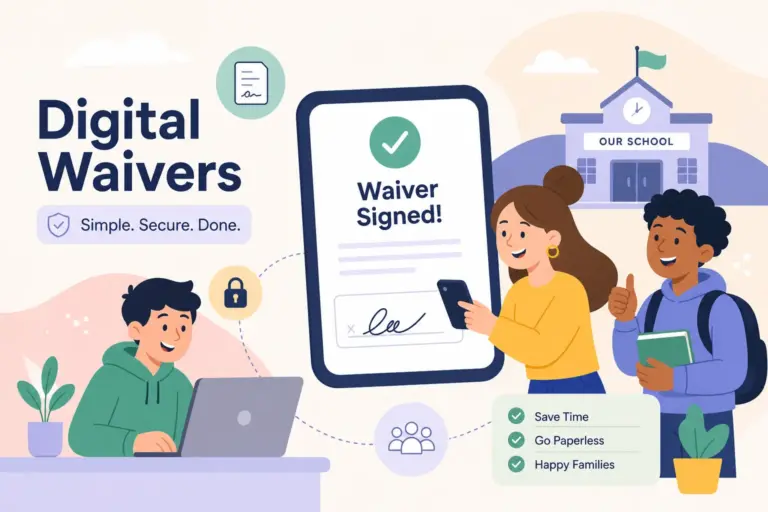
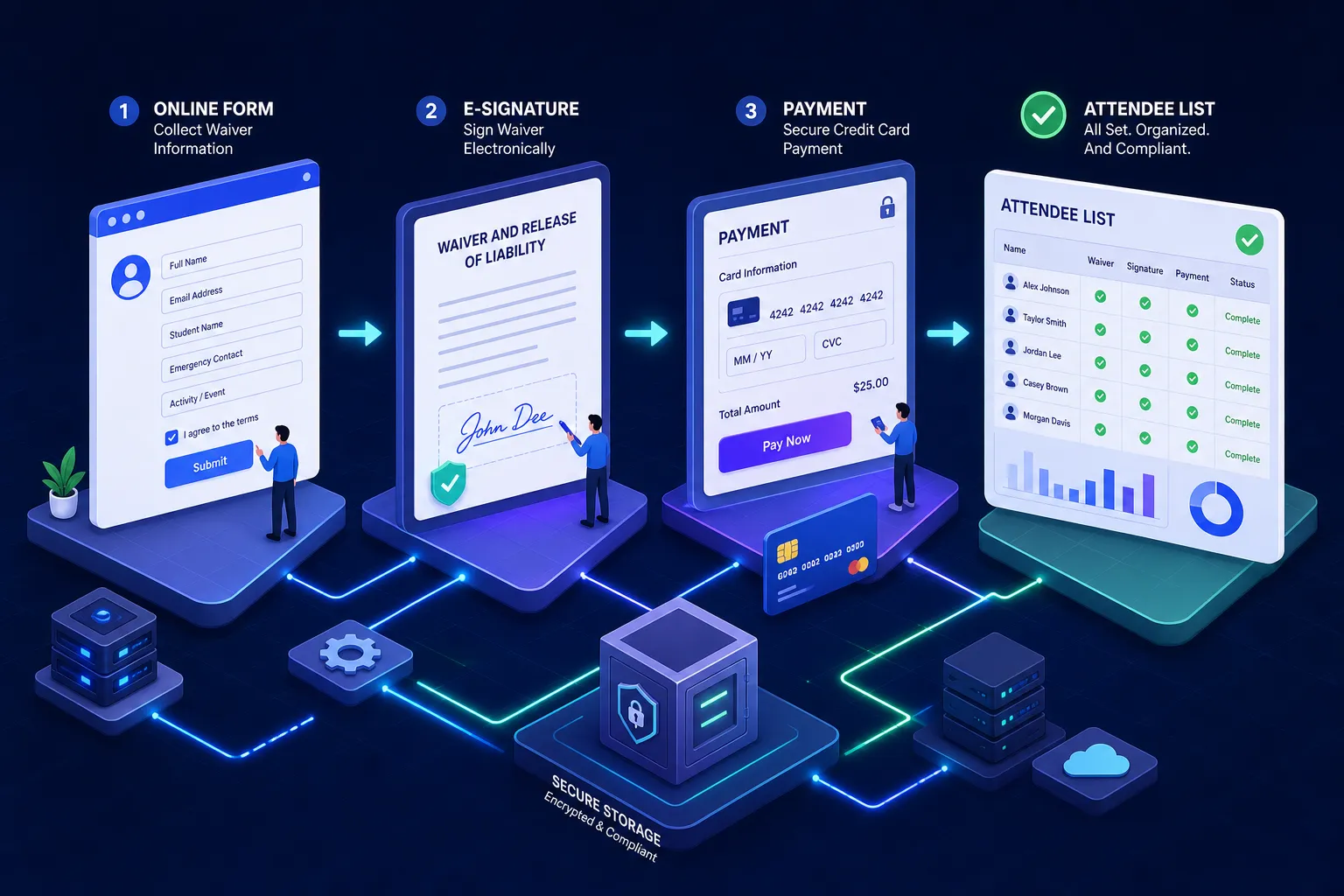
The shift from paper to digital doesn’t require a big technical project. A coordinator builds the waiver form digitally, adds the required fields, emergency contact, medical notes, and the activity-specific risk acknowledgment, and then sends a single link to the entire class or parent list. Parents open it on their phone, review the terms, e-sign, and pay any trip fee that applies.
No app download. No printing. No packet sent home in a backpack.
Form fields that matter
Every enrollment agreement waiver should capture the activity name, date, and location; the risk acknowledgment language; the parent’s e-signature; and any Field Trip Permission Slips & Payments or fee waiver status. Medical and emergency contact fields round out the form so the information you collect before the trip is the same information chaperones need during it.
Bulk sending and SIS integration
Bulk sending via CSV upload eliminates the manual step of entering parent contact information one by one. For schools running Veracross, SignPayGo offers a direct SIS connection that pulls student and family data into every form, so rosters stay in sync and coordinators aren’t re-entering information they already have. Review SignPayGo’s integration documentation or contact their support team to confirm current compatibility with your SIS configuration.
Automated reminders
Automated reminder sequences replace the uncomfortable task of hunting down unsigned forms. When a parent hasn’t responded by a set date, the system follows up without any manual effort from your team. Coordinators get their evenings back, and the follow-up happens consistently rather than depending on who has bandwidth that week.
Storing, tracking, and staying audit-ready
Signed waivers and consent records are part of a student’s educational record and fall under FERPA’s privacy protections for schools receiving federal funding. Best practice is to store them in an encrypted, access-controlled digital environment rather than a filing cabinet that anyone with a key can open. Paper records get lost, misfiled, or simply thrown away when a coordinator cleans out their office.
FERPA itself does not specify a retention period for permission slips and activity waivers, but state education codes typically apply. Many states treat these as temporary records subject to a retention schedule commonly in the range of five to six years after the student leaves the school, though that window varies by jurisdiction. Your school’s legal counsel or state education department can confirm the exact schedule that applies to you. Waiver compliance and record retention are easier to manage when your digital system enforces the retention window automatically, records are purged on schedule rather than accumulating indefinitely.
A real-time dashboard that shows who has signed, who has paid, and who still needs a reminder changes the morning of a field trip entirely. Exportable rosters in CSV and PDF formats mean the coordinator prints exactly what the bus driver and chaperones need, without improvising from a spreadsheet at 6 a.m.
Why SignPayGo fits the independent school waiver workflow
SignPayGo brings the waiver submission process together in one place. The custom form builder handles emergency contacts, medical notes, and activity-specific risk acknowledgments. Legal e-signatures are collected and stored with full audit trails. Integrated payment processing means trip fees can be collected alongside consent, no stitching together a separate form builder, payment processor, and signature tool.
Administrators working in Veracross already have the student and family data they need; SignPayGo’s SIS connection puts that data to work directly in the waiver workflow. Rosters stay synchronized, and coordinators spend less time reconciling systems and more time on the work that actually matters. For schools evaluating digital waiver platforms, that kind of integration can meaningfully reduce administrative overhead, verify current integration details with SignPayGo directly to confirm the fit for your setup.
The practical case for modernizing your independent school waiver collection
Picture the coordinator on field trip morning. One version has them flipping through a folder of paper, calling out names, and hoping no one slipped through. The other version has them glancing at a dashboard on their phone that shows every signature collected and every payment confirmed before the first student boards the bus. That’s the difference a well-built digital workflow makes.
The fundamentals of sound independent school waiver collection are straightforward. Use activity-specific waivers with the six required legal elements. Collect e-signatures that meet ESIGN Act standards. Automate reminders so follow-up happens without manual effort. Store records in an encrypted system built for waiver compliance and record retention, one that’s ready for an audit or a legal inquiry if the need arises.
Try SignPayGo free and see how quickly you can move from paper chaos to a clean, compliant waiver collection workflow. Most schools are up and running well before their next event.