Picture this: it’s 7:45 AM on field trip day, the bus arrives in fifteen minutes, and you’re still hunting for three paper permission slips that were sent home three weeks ago. One parent says they signed it. Another swears it was returned. The third isn’t answering their phone. The stakes here aren’t just logistical. Running a youth program without properly executed consent documents in place leaves your organization legally exposed in ways most coordinators don’t fully recognize until something goes wrong.
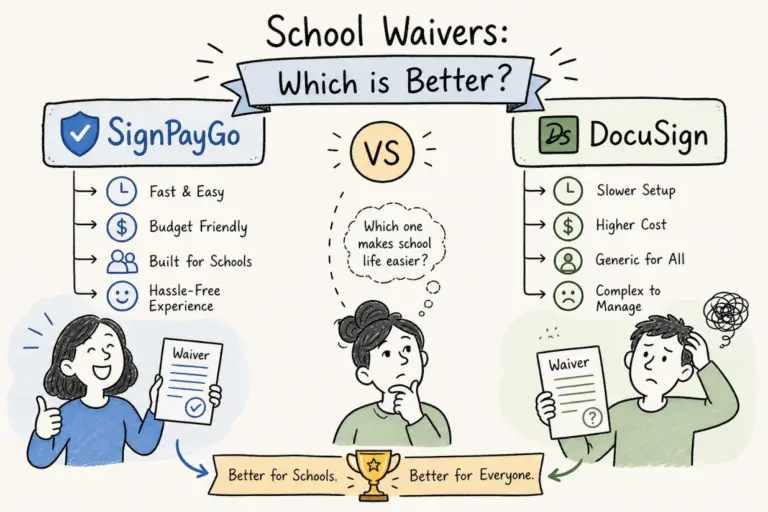
This guide covers exactly which release forms youth organizations need, what language makes them hold up in court, and the mistakes that get them thrown out. Platforms like SignPayGo are changing how coordinators handle this entire process, moving signed forms, payments, and parental consent from backpack chaos to a single organized dashboard. You’ll leave with a clear picture of what to require, what to include, and how to make sure every signature is collected, stored, and retrievable before any event begins.
Why youth organizations can’t afford to skip proper waivers
Working with minors creates a distinct category of legal exposure. When children are involved in injuries, medical incidents, or consent violations, courts look closely at whether the organization took proactive steps to document risk acknowledgment and inform parents ahead of time. A missing waiver isn’t just a paperwork gap, it’s evidence that proper procedures weren’t followed, and that framing matters enormously in a legal dispute.
The core legal concept behind liability waivers is “voluntary assumption of risk.” When a parent or guardian signs, they acknowledge the known risks of an activity and agree not to hold the organization liable for ordinary injuries that fall within those risks. This protection is real, but it has clear limits. It does not cover gross negligence, unsafe conditions the organization created, or incidents that fall outside the described activity. Understanding this distinction early helps coordinators see why waiver language must be specific rather than generic, and why a vague “all risks” clause is weaker than it looks. For a practical overview of waiver and release concepts, see waiver and release guidance.
The three types of waivers every youth program needs
Most coordinators know they need some kind of release form. Fewer realize there are three distinct documents that serve entirely different purposes, and that each one fills a gap the others don’t.
Liability waivers and release of claims
A liability waiver, also called a release of liability, is the document where a parent acknowledges the risks of an activity and agrees not to sue for injuries arising from ordinary participation. A well-written version identifies the specific activity, the dates or program involved, every party being released (the organization, staff, and volunteers), and a clear description of the risks involved. Vague language like “all risks of any kind” weakens enforceability significantly because courts expect these releases to be proportionate and focused, not blanket disclaimers.
Enforceability of parental waivers for minors varies significantly by state. Roughly 25 states refuse to uphold these forms as a matter of public policy, while others enforce them when the language is clear and specific. This doesn’t mean you skip the waiver in uncertain jurisdictions. It means you invest in well-crafted language and consult local counsel to understand your state’s current position, for example, see analyses on enforceability of liability waivers signed on behalf of minor children.
Medical release forms
A medical release form serves a completely different function than a liability waiver. It authorizes the organization to seek emergency medical treatment for a child when the parent can’t be reached, and it captures the information staff need to act safely: allergies, current medications, chronic conditions, emergency contacts, and the family’s preferred hospital or provider. Many organizations treat this form as optional. It isn’t. Without it, staff face impossible decisions during a medical emergency, and the organization faces serious exposure if the wrong decision is made in the absence of documented guidance.
A complete medical release should also include immunization status, any physical or behavioral conditions relevant to participation, and written authorization for diagnostic procedures, transportation, and hospitalization if needed. The American Camp Association recommends these components as a baseline, and they represent genuinely useful information, not just legal formality.
Photo and media consent forms
Photo consent is the waiver type youth organizations most consistently overlook. If your program posts photos on social media, uses images in newsletters, or shares video from events, you need written parental permission before doing so. Privacy law considerations aside, parents expect to be asked before their child’s image is published anywhere. For practical examples of photo release language and options, review a photo release and waiver guide.
A clear photo consent form should specify where images may appear (social media, print materials, the organization’s website), whether the child’s name can accompany their photo, and how parents can opt out without affecting their child’s participation. Including a simple opt-out checkbox, rather than making refusal feel like an unusual request, builds trust with families and demonstrates that your organization takes privacy seriously. That goodwill matters as much as the legal protection.
What makes a waiver legally enforceable
Courts expect consent documents to clearly identify the rights being given up, name the specific risks being acknowledged, and identify all parties involved. The release needs to state, in plain terms, that the signer is giving up the right to sue for injuries related to the described activity. Generic boilerplate fails this test more often than coordinators expect, which is why a waiver form for a rock-climbing program should describe rock-climbing risks specifically, not just reference “physical activity.” For a concise legal definition of what a waiver is and how courts treat it, consult this legal glossary entry on waivers.
Always require the parent or legal guardian to sign, never the student. Minors cannot legally sign contracts, so their signatures on waivers are unenforceable nationwide. Include a checkbox confirming the signer’s relationship to the child (parent, legal guardian) and make this a required field rather than an afterthought. Courts in some states already scrutinize parental waivers for minors closely; a release signed by an older sibling or an unchecked relationship field gives a court an easy reason to disregard it entirely.
No waiver protects an organization from gross negligence. If a supervisor knowingly ignores a hazard and a child is hurt, the signed release provides no shield. Courts distinguish clearly between ordinary risk, which waivers can address, and reckless or willful disregard for safety, which no document can excuse. A signed consent form is one layer of protection in a broader safety strategy, not a replacement for maintaining safe conditions and trained staff.
Common mistakes that get waivers thrown out
The most frequent language failures courts reject involve phrases like “any claims whatsoever,” “regardless of cause,” or “all risks” without specifics. Courts interpret these as overreach, not careful drafting. A release form for a swimming program that names water-related risks, supervision ratios, and the specific location will hold up better than a one-size-fits-all template that hasn’t been updated since 2015. The more tailored the language, the stronger the protection.
The second category of mistakes involves storage and collection. Even a perfectly written waiver fails if you can’t prove it was signed. Paper forms get lost, never make it back from backpacks, or live in an unlabeled folder that nobody can locate during a dispute. Organizations relying on paper collection often discover on the morning of an event that 20 percent of families never responded, and the scramble to fix that problem in real time is both stressful and risky. Equally damaging is being unable to produce a signed release during an insurance claim or legal proceeding because it was never stored systematically in the first place.
How to collect and store signed waivers without the paper chase
The shift from paper-based collection to digital waiver software has become standard practice for well-run camps, school programs, and youth organizations. A digital waiver reaches parents directly via email or a shareable link, can be completed from any smartphone in under two minutes, and creates an automatic timestamped record the moment it’s signed. Automated reminders follow up with families who haven’t responded, without the coordinator making a single phone call or sending a second round of backpack notes. For organizations running seasonal programs, see examples like Summer Camp Waivers & Registration, www.signpaygo.com for how templates and workflows can be organized.
SignPayGo is purpose-built for exactly this workflow. Unlike generic form builders that require stitching together separate tools for e-signatures, payments, and follow-up reminders, SignPayGo handles liability waivers, medical release forms, photo consent, and payment collection through a single shareable link. Coordinators build their forms once, send them to entire rosters via CSV upload, and track every response in real time from a centralized dashboard. Signed releases are stored securely and can be exported for audits or insurance reviews at any time, without hunting through filing cabinets. If your program uses sport-specific registration pages, you can mirror that structure with resources like Football Camp Permission Slips & Waivers & Payments and Soccer Camp Waivers & Registration, www.signpaygo.com.
The day-of experience changes completely when digital collection is done right. You log in, pull up the dashboard, and see exactly who has signed every required document and who still hasn’t. If three parents haven’t completed the medical release form, the system has already sent two automated reminders on your behalf. The signed documents are accessible immediately if an incident occurs, and the exportable roster is ready before the bus pulls out. Contrast that with a coordinator rifling through a folder during a medical situation because the paper forms were never organized properly. The difference isn’t just efficiency, it’s the kind of documentation that protects your organization when it matters most.
Getting your waiver process right from the start
Liability waivers, medical release forms, and photo consent forms each serve a distinct legal and operational purpose, and all three require specific, clear language to be enforceable. Getting signatures is only half the job. Storing them securely and being able to produce them instantly is the other half, and it’s the part most organizations underestimate until they need those documents in a hurry.
The coordinators who have modernized this process aren’t spending Friday afternoons chasing parents or arriving at field trips hoping everyone’s paperwork made it back. They set up their forms once, send one link, and let automated reminders handle the follow-up. If you’re ready to stop managing consent documents through a mix of paper forms, spreadsheet tracking, and optimistic hope, SignPayGo is where you build all three waiver types, collect e-signatures, process payments, and manage the entire consent workflow in one place, whenever you’re ready to make the switch.