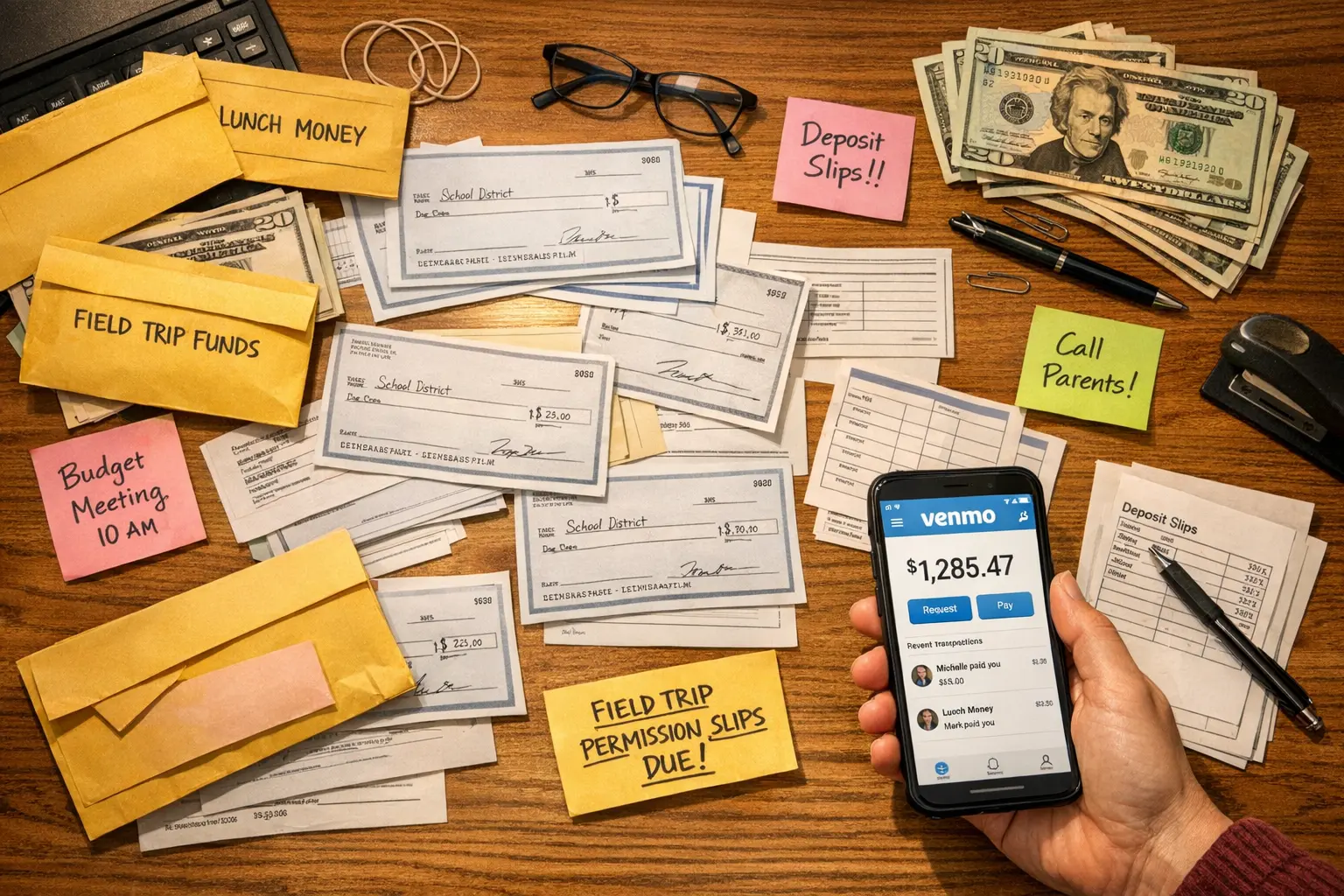
It is field trip week. Your front office has received 47 checks, 31 Venmo payments, 12 Zelle transfers, and 8 cash envelopes. Six checks have no student name on them. Four Venmo payments say “field trip” with a smiley face emoji. Three parents insist they already paid, but there is no record of it.
Somewhere in that pile is $1,400 that needs to be reconciled, matched to students, and confirmed before the bus leaves Friday morning.
This is costing more time and causing more stress than most administrators want to admit.
The Venmo Problem Nobody Talks About
Venmo feels convenient. Parents like it. So schools started accepting it, often informally, and now it is embedded in the process whether administrators planned for it or not.
Here is the problem: Venmo was built for splitting dinner bills between friends. It was not built for matching 300 payments to 300 students across 20 different events running simultaneously.
- A payment notification to whoever’s personal account is being used — often a teacher or secretary’s private account
- A memo that may say “Tyler field trip,” “FT,” “May trip,” or nothing at all
- No automatic connection to any student record, form, or event
Now multiply that by your entire school. Every event. Every form. All year.
The Check Problem Is Even Older — and Just as Bad
Checks have been the default school payment method for decades. They feel official. They leave a paper trail. But in practice, they create just as much chaos.
| Issue | What It Means for Staff |
|---|---|
| No student name on the check | Staff must track down the parent, sometimes days later, just to find out what the payment is for |
| Wrong amount | Someone has to decide whether to chase the difference, issue a credit, or absorb the discrepancy |
| Check never arrives | The student says they handed it in. The teacher says they passed it to the office. Nobody is lying. It is just gone. |
| Bounced check | Rare, but the bank fee often costs more than the payment itself |
The Reconciliation Black Hole
The real cost is not any single lost check or mystery Venmo payment. It is the reconciliation process at the end of every collection cycle.
Someone — usually the front office secretary, sometimes a teacher, occasionally the principal — has to sit down and match every payment against every student who was supposed to pay. They are cross-referencing a spreadsheet, a stack of checks, a phone’s Venmo history, and a mental list of who said they would bring cash tomorrow.
The Confusion That Falls on Families, Too
It is not just staff who suffer. Parents get caught in the confusion as well.
This happens constantly in schools that rely on informal payment methods. And every time it does, it erodes a little bit of trust between the school and its families.
What a Linked Payment System Actually Solves
The core problem with checks and Venmo is not the payment method itself. It is that the payment is disconnected from the person and the event.
When a parent pays through a system where the payment is tied directly to their child’s name, the specific event, and the permission form all at once, the reconciliation problem disappears. Every payment arrives already labeled, already confirmed, already connected to the right student.
- Staff do not need to sort checks
- Staff do not need to decode Venmo memos
- Staff do not need to chase down parents who insist they already paid
- The system knows who paid, for what, and when — automatically
The Shift Schools Are Making
More schools are moving to platforms that combine the permission form and the payment into a single step. A parent receives one link, reviews the form, signs it, and pays — all in under two minutes, from their phone. The payment is automatically tagged to their child and the event.
- No loose checks stuffed in backpacks
- No mystery Venmo transfers with emoji memos
- No reconciliation spreadsheet at the end of every event
- No parents calling to prove they already paid
“Before we switched, I spent two hours every field trip Friday just matching checks to names. Now it takes maybe five minutes to confirm everyone is cleared.”
— Elementary school secretary, Austin TXSignPayGo was built exactly for this.
One link to the parent. One step to sign and pay. Every payment automatically matched to the right student and event. Your front office sees a clean, organized record — not a pile of envelopes and a Venmo inbox to sort through.
See How It Works → Learn moreThe Bottom Line
Checks and Venmo are not inherently bad. They are just the wrong tools for school payment collection. They were never designed to track who paid for what on behalf of which child — and the gap between what they do and what schools need is where all the wasted time lives.
If your front office is still reconciling payments by hand at the end of every event cycle, there is a better way. And it is simpler than you think.
