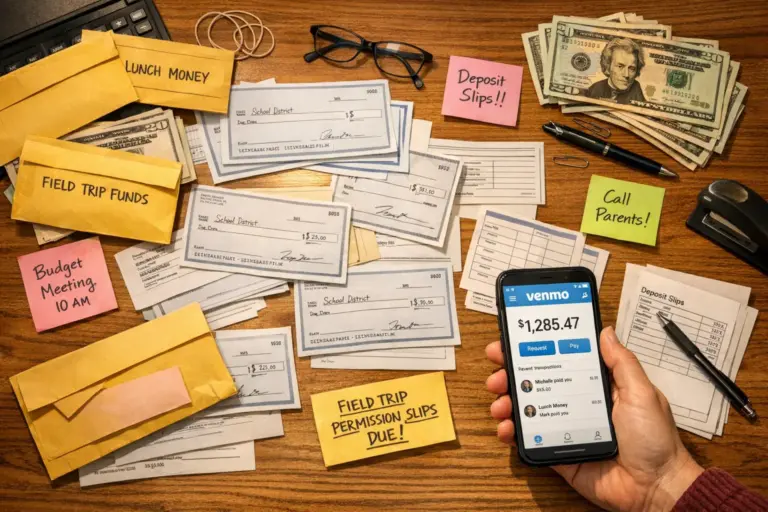
How do teachers collect money for field trips without chaos? If you have ever stood at your desk with a stack of crumpled dollar bills, a handful of handwritten checks, and twenty-eight voices asking if they are on the list, you know the stress of field trip money collection. You count, recount, and still wonder which envelope is missing and who you need to follow up with. By the end of the week, the admin work feels bigger than the trip.
The truth is simple. Many teachers still use systems that create more work than the bus ride: lost envelopes, missing checks, and zero real-time tracking. This guide shows a clean path forward. You will see the pros and cons of common field trip payment methods, what your district actually requires, and how a tool like SignPayGo can turn the whole process into a five-minute job.
I run SignPayGo and I have spent two decades helping schools, camps, and youth programs get permission slips and payments off paper. You deserve a process that is safe, school-compliant, and kind to your time. That starts with the next trip you plan.
How Do Teachers Collect Money for Field Trips the Traditional Way?
Cash envelopes and the counting problem
The classic approach asks students to bring in cash labeled in an envelope, then you count it, log it, and tuck it in a drawer until you can get to the office. It sounds simple until one envelope goes missing, a ten looks like a twenty, or you forget to send a receipt home. Many classroom cash handling policies require a second adult to verify cash counts, which adds coordination time you do not have.
Cash is a common method, and often the heaviest administrative lift. There is no automatic receipt, no built-in ledger, and no easy way to prove who paid if a parent asks later. You end up doing bookkeeping by hand.
Checks and the deposit delay
Checks feel safer because names are printed and you can match a payment to a student. In practice, you still face bounced checks, delayed deposits, and handwriting errors that do not match your roster. Most teachers wait until enough checks accumulate to justify a trip to the office, which delays confirmations and creates reconciliation headaches.
In many classrooms, that reality means carrying both systems at once, and doubling your tracking work.
What district policy requires before you collect a single dollar
Most districts require written approval for the trip before any money changes hands. Once approved, funds must be used only for the authorized trip, every payment must be documented, and students cannot be excluded because a family cannot pay. Those rules also sit alongside permission requirements and school safety expectations. Check your own district’s field trip handbook to confirm the exact requirements.
Think of this as the compliance floor. Whatever method you use to collect money needs to document dates, amounts, and payers, funnel funds through approved channels, and align with your school’s non-exclusion policy. For classroom teachers, meeting this floor means fewer last-minute scrambles and easier conversations with families and the office.
How Do Teachers Collect Money for Field Trips? A practical comparison of methods
Cash and checks: familiar but fragile
The advantages are straightforward, no setup, no tech barrier, and universal family access. Cons matter more: no automatic tracking, manual receipts, and higher compliance risk if documentation is incomplete or goes missing. If a parent disputes a payment, cash and checks trigger the toughest audits because the paper trail depends entirely on your logs.
If you must handle cash, follow your classroom cash handling policy to the letter. Count with a second adult, issue numbered receipts, deposit promptly, and keep your trip ledger current.
Generic online tools: better than paper but still incomplete
Tools like PayPal, Venmo, or a Google Form with a Stripe link move money online, which helps. The catch is separation: payment happens in one place, the permission slip lives in another, and you chase both. You may also lose built-in consent tracking, exportable rosters, automated reminders, or a real-time dashboard that ties consent to payment, depending on how the tools are set up.
Many districts restrict the use of personal payment accounts for school fees, so check policy before you collect. Without a school-approved system, you still end up stitching together spreadsheets and screenshots. We documented this problem in Why Schools Are Drowning in Venmo Requests and Loose Checks, www.signpaygo.com.
Purpose-built school payment platforms: what to look for
Schools in 2026 are moving toward centralized platforms that tie fees directly to student records. District-managed systems such as SchoolCash or RevTrak field trip registration software often handle meals, activities, and donations. For field trips, look for a flow that combines payment with the permission slip, sends automated reminders, tracks everything in real time, works well on phones, and produces an exportable roster for day-of logistics.
Some districts already provide one of these systems. If yours does not, or if you need a flexible classroom-level workflow that blends permission slips and payment collection, you can use a focused tool like SignPayGo to cover the entire trip in one link (subject to district approval).
How SignPayGo turns a two-week chase into a single shareable link
One link for payment and permission: why that matters
SignPayGo is designed to put the permission slip and the payment in the same place. You add emergency contacts, medical notes, and dietary info, then set the fee and deadline. According to SignPayGo’s product materials, families can open the link on any phone, sign the waiver (see Football Camp Permission Slips & Waivers & Payments), and pay by card or mobile wallet, with no separate app required.
One link can significantly reduce manual reconciliation. You avoid handling cash and reduce the need to cross-reference spreadsheets. Each response is time-stamped and tied to the right student within the system. If you still rely on paper, read The Hidden Cost of Paper Permission Slips, www.signpaygo.com.
Automated reminders that do the follow-up for you
SignPayGo includes optional reminder emails to families who have not responded yet (per vendor materials). That means fewer “just a reminder” messages on your plate and fewer envelope hunts at dismissal. A real-time status view shows who has signed, who has paid, and your total collected at any moment.
When questions come in, you have instant answers. The system-level view calms parents, supports your admin, and keeps the trip on schedule.
Exporting a ready-to-go roster for trip day
When the deadline hits, you can export a CSV or PDF roster with signatures confirmed, payment status noted, and medical notes included. You walk into trip day with the list you need, not a pile of envelopes. Verify with your office that the export format satisfies local recordkeeping requirements.
Budget matters. Check SignPayGo’s current pricing and plans to see options that work for classroom budgets.
Tracking payments and staying on the right side of district policy
What solid field trip payment recordkeeping looks like
Strong controls protect you and your families. Every payment should be logged at the point of receipt with the student name, date, amount, method, and trip name. Numbered receipts go to parents right away, with a copy for the trip file, and you reconcile regularly rather than waiting until the end.
- Record the payment immediately in your trip register or platform.
- Issue a numbered receipt and send it home or via email.
- Secure cash and turn it in promptly to the office if your policy requires it.
- Deposit funds through the approved school channel and note the deposit reference.
- Reconcile your register with deposits or platform reports on a schedule.
- Keep all supporting documents together: roster, permission forms, deposit slips, and final reconciliation.
How digital tools create an automatic paper trail
When families pay through a platform, the confirmation email is the receipt and the dashboard is the ledger. It records dates, amounts, and payer details without extra work. This reduces the biggest risk in manual collection: a parent says they paid, and you cannot find proof.
Many purpose-built platforms provide audit-friendly exports and reports; SignPayGo offers downloadable reports designed to align with typical school bookkeeping, subject to district acceptance. That export becomes your audit-ready trail, complete with time stamps, payment status, and consent records tied to each student.
The one compliance step teachers most often skip
Get written trip approval before you collect a dollar. Most districts require this, and it protects you if plans change. A digital tool helps by letting you set a collection window tied to the approved trip, so the sequence is correct by design.
If your classroom cash handling policy sets extra conditions, load them into your routine and stick to them. You win time and reduce stress when your process matches policy from day one.
When the budget is the barrier: grants, PTO support, and fundraising options
Field trip grants worth applying for right now
Grants can close the gap for transportation, tickets, and materials. These programs are teacher-friendly and focused on trips that build real-world learning. Plan ahead, because most cycles need lead time for approval and disbursement.
- Target Field Trip Grants: up to $700 for transportation, admission, food, and materials, nationwide.
- American Battlefield Trust History Field Trip Grant: up to $3,000 for transportation and admission to history-related sites, nationwide.
- NatureBridge Kids to Parks School Grants: up to $1,000 for Title I classes, Pre-K through Grade 12, nationwide.
- State and local examples: Colorado DOE arts trip funds up to $2,000 and Bay Area environmental field trip subsidies through local nonprofits.
For a broader list of opportunities, see this field trip grants directory, and for sample program guidance you can review this field trip funding guide.
PTO/PTA funding and low-cost fundraising ideas
Most PTO/PTA groups maintain a subsidy fund for school trip costs or approve one-off requests. A one-page proposal with a clear cost breakdown, dates, and headcount usually gets your ask on the agenda fast. Pair that with one simple event or campaign to cover any shortfall.
- Crowdfunding on DonorsChoose or GoFundMe to reach families, alumni, and community supporters.
- Trivia or game night with entry fees, run in the gym with donated snacks.
- Raffles or silent auctions using prizes from local businesses or parent donations.
- Walkathons or readathons with sponsor pledges and a simple tracking sheet.
Making sure no student gets left behind
District policy typically says students cannot be excluded because a family cannot pay. Build equity into your plan so you never face a last-minute decision. Set aside a small scholarship line in the budget and direct fundraising overage toward fee relief.
Communicate support privately to reduce stigma. Some platforms let you mark fee waivers or scholarships in the record so the roster stays accurate without broadcasting who received help. SignPayGo supports private notes and adjustments for this purpose, according to vendor materials. Equity is a design choice, not an afterthought, and your tool should make it easy.
Choose the method that protects you and includes every student
Cash, checks, and generic online tools each leave a gap, in documentation, in consent tracking, or in both. Purpose-built options handle permission slips and payment collection together and give you the roster and reports you need.
The right method protects you legally, keeps parents in the loop, and gets every student on the bus. So when a colleague asks, “how do teachers collect money for field trips,” you can point to an integrated, policy-aligned workflow that saves hours, often with a single shareable link through SignPayGo.
Create your trip in SignPayGo, share one link, and let the reminders and real-time tracking do the heavy lifting. Get started today.